The New Encyclopedia of Southern Culture by Holt Thomas C. Green Laurie B
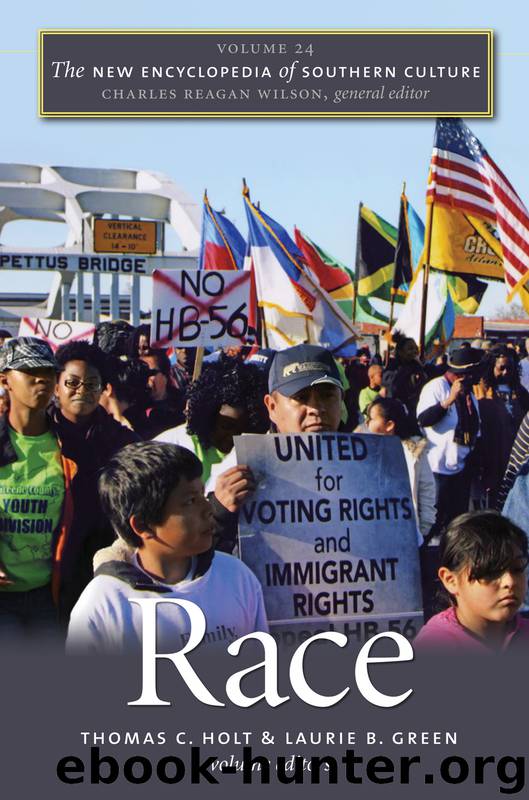
Author:Holt, Thomas C., Green, Laurie B.
Language: eng
Format: epub
Publisher: The University of North Carolina Press
Published: 2013-03-14T16:00:00+00:00
Segregation, Desegregation, and Resegregation
Segregation is the practice of physically separating categories of individuals on the basis of socially determined ethnic, gender, racial, or religious attributes. Segregation can be voluntary or involuntary, sanctioned by law (de jure) and by custom (de facto). Desegregation is the process of undoing the different legal, social, economic, and political practices supporting segregation; resegregation refers to reverting to segregation practices, though sometimes in different ways. In the South, the segregation of blacks was woven into the entire scope and scale of the community. Desegregation attempted to end segregation by challenging it through particular institutions deemed egregious—schools, lunch counters, public transportation. Through the flight of better-educated and wealthier people—white and black—from communities in recent decades, the remaining poor (and usually black) residents have been subject to a resegregation perhaps more pernicious than the previous forms of segregation.
Social practices arising around segregation are usually justified by an ideology of one group’s superiority over another. In the South, the justification for segregation was the belief in white supremacy, that whites were inherently better—morally, physically, and intellectually—than blacks (the principles of white supremacy continue to permeate the American consciousness today, particularly in white opposition to immigration). Though voluntary segregation was more likely in the North, involuntary physical separation of blacks from whites was the predominant structure of segregation in the South.
Slaves had no choice but to live in close proximity to their masters in rural areas. The few free blacks in the South had a tenuous status and lived in designated sections of towns, barred from most public accommodations. Yet during this period, free blacks created their own separate community by forming their own religious, fraternal, and benevolence institutions. These segregated institutions helped to sustain a distinct black identity in the face of white hostility and widespread discrimination.
During the antebellum period and continuing just after the Civil War, the status of blacks was defined by Black Codes or laws enacted by all states in the Deep South. These statutes defined the near-absolute power slave owners had over their slaves, including over their sexual relationships and offspring. Though these codes prohibited slaves from marrying anyone, particularly whites, they also contributed to an ideology of white racial purity, which was given form through appeal to white women. The belief in an inviolate white womanhood or rape myth provided a ready excuse for lynching blacks who were too “uppity,” serving to maintain strict racial boundaries separating whites and blacks.
After the Civil War, the Thirteenth Amendment (1865) abolished slavery; blacks were granted citizenship with equal rights, and black males were then granted voting rights (Fourteenth Amendment, 1868). The Fifteenth Amendment (1870) prohibited racial discrimination in voting. These and other federal laws initially protected blacks’ civil liberties and civil rights during Reconstruction. But after the withdrawal of federal troops in 1877, the less-frequent interventions in the South by Congress and the tightening of local control by white elites allowed the reinstating of exclusionary social practices toward blacks.
Between 1890 and 1965, southern states sponsored a system of racial segregation, colloquially termed “Jim Crow.
Download
This site does not store any files on its server. We only index and link to content provided by other sites. Please contact the content providers to delete copyright contents if any and email us, we'll remove relevant links or contents immediately.
Whiskies (Collins Gem) by dominic roskrow(45527)
Spell It Out by David Crystal(36236)
Cecilia; Or, Memoirs of an Heiress — Volume 1 by Fanny Burney(32720)
Cecilia; Or, Memoirs of an Heiress — Volume 2 by Fanny Burney(32088)
Cecilia; Or, Memoirs of an Heiress — Volume 3 by Fanny Burney(32065)
Beautiful Disaster by McGuire Jamie(25452)
Trainspotting by Irvine Welsh(21971)
Chic & Unique Celebration Cakes by Zoe Clark(20149)
The Secret History by Donna Tartt(19468)
How High Can a Kangaroo Hop? by Jackie French(18843)
Twilight of the Idols With the Antichrist and Ecce Homo by Friedrich Nietzsche(18775)
All the Missing Girls by Megan Miranda(16697)
Cat's cradle by Kurt Vonnegut(15555)
Ready Player One by Cline Ernest(15139)
For the Love of Europe by Rick Steves(14907)
Fifty Shades Freed by E L James(13349)
4 3 2 1: A Novel by Paul Auster(12611)
Crooked Kingdom: Book 2 (Six of Crows) by Bardugo Leigh(12453)
Grundlagen Kreatives Schreiben (German Edition) by Helfferich Pia(10522)
